
Machinery Manufacturing
Between the motor and the thing it drives there is always a joint. If that joint has backlash, the encoder lies; if it is too stiff for the misalignment, the bearings pay for it. This is where couplings and keyless bushes decide whether a machine holds its position.
Where the joint sits
Two places, on almost every machine we supply into. The coupling connects a motor shaft to what it drives — an encoder, a ball screw, a positioning table. The keyless bush fixes a pulley, sprocket or timing belt wheel onto a shaft without a key.
Typical applications from our own catalogue: shaft encoders, resolvers, step motors, servo devices, linear and ball screw actuators, robots and positioning tables.
What goes wrong at the joint
- Shafts never line up
- Angular, parallel and axial offset are all present in a real assembly. A rigid joint passes the error into the bearings; a sloppy one loses position.
- Backlash falsifies feedback
- Any play between motor and encoder means the controller is reading a position the load is not at. Stop-and-go and reverse motion make it worse every cycle.
- The motor is heard, not felt
- Vibration travels down the shaft into the frame — a quality problem on instruments and a noise problem everywhere else.
- Keyways are a commitment
- A keyed hub fixes the angular position when you cut it. Adjusting it later means a new part.
Pick the joint for the error you have
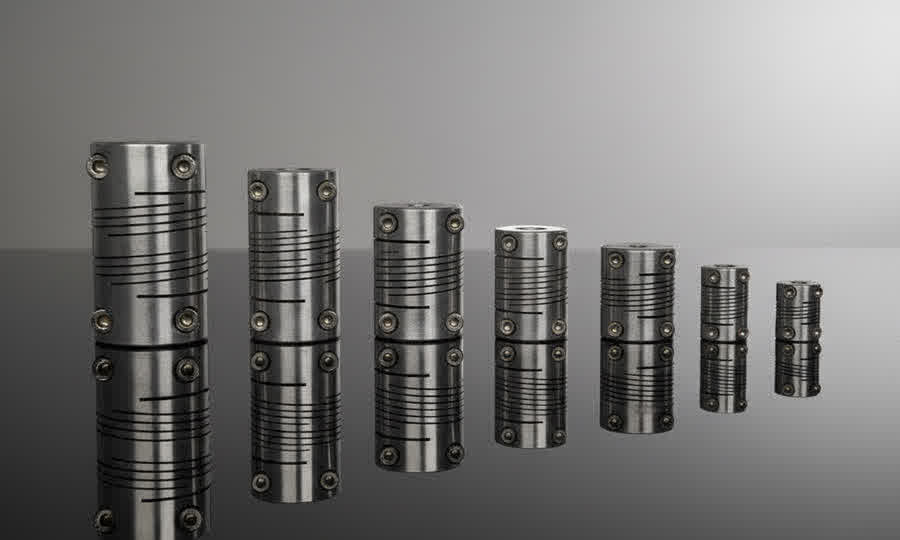
Beam coupling
One-piece helical or multi-beam design. Takes angular, parallel and axial offset at once while keeping high torsional stiffness — and does it without vibration or noise. Our first metal product, made since 1995.
Aluminium parallel
Very high torsional stiffness for accurate positioning, frequent stop-and-go and reverse rotation. Metric, inch and inch-to-metric bores with H7 tolerance.
Keyless bush
Zero backlash, precise radial and axial adjustment on the shaft — and it mounts over an existing keyway, so a keyed shaft is not a dead end.
Where the drive should be damped rather than stiff, the silicone insert coupling takes the vibration out; where there is no misalignment at all, the stainless rigid coupling in 1.4305 is the simplest answer. For larger angular error, the Easy coupling handles up to 3°.
Two product lines
Dimensions before you ask
Most of what you need to specify is already published.
Every coupling family and both bush lines have their own datasheet, and the BS line has a published tightening torque table. The size selector narrows the bushes to your shaft diameter and torque in two fields.